We respect your privacy











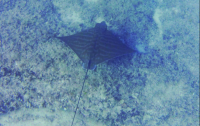
From the beginning of July until this week, we have received 15 reports of bull ray (Aetomylaeus bovinus) sightings. This critically endangered species can reach a disc width of up to 222 cm. Six of the reports were confirmed by photographs or detailed descriptions, with confirmed individuals recorded in the areas of Pula, Ližnjan, Šišan and Rovinj, as well as on the island of Cres. Other reports, which we believe most likely refer to this species, came from other parts of Istria and from the islands of Krk, Vir and Murter.
The bull ray was not recorded at all during several surveys of northern Adriatic fauna conducted in the second half of the 20th century and was considered a rare species. However, a study conducted by Dulčić and colleagues in 2005 in the southern Gulf of Trieste and along the western coast of Istria recorded 32 individuals, including newborn individuals and pregnant females, suggesting that the species may reproduce in the northern Adriatic.
The authors proposed two possible explanations for the higher number of recorded individuals compared with previous studies: the species may have been underreported in past catches due to its low commercial value, or it may have been expanding northwards, potentially in connection with rising sea temperatures (Dulčić et al., 2008: The bull ray, Pteromylaeus bovinus (Myliobatidae), in the northern Adriatic Sea).
Although it is not yet possible to determine with certainty whether A. bovinus is permanently expanding northwards or whether its population is increasing, 2026 has brought an exceptionally high number of sightings in the northern Adriatic. At the beginning of the summer, the largest aggregations recorded to date in the Miramare Marine Protected Area in Trieste were observed around mussel farms, including a group of more than 50 individuals.
These findings highlight the need for systematic monitoring to determine whether the increased number of sightings represents an occasional phenomenon, seasonal aggregation, or a long-term change in the species’ distribution.
For this reason, we would like to sincerely thank everyone who reported their observations to us, and especially Mariella Schratl for sending us photographs and video footage!