We respect your privacy









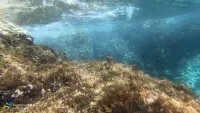
The sight of a tropical spinefoot in an indigenous “forest” of brown algae called cystozira, which we recorded this week on Mljet, is not just an interesting detail, but a clear sign of change. It shows how much the Adriatic is changing, but also how fragile these habitats are at the same time, dependent on a delicate balance between new species and what has existed here for centuries.
Not so long ago, cystozira dominated the rocky shores of the entire Adriatic, in the so-called infralittoral zone, a zone that is constantly submerged, well-lit and below the limit of the stronger influence of waves. They formed dense “underwater forests” that, along with posidonia meadows, represented centers of biodiversity because they serve as spawning grounds, feeding grounds and growing grounds for numerous fish and invertebrates.
Today, in the Adriatic, a clear connection can be observed between the abundance of cystosira and Mediterranean rainbow wrasse (Coris julis), because both depend on preserved coastal habitats, and the situation is reversed in the northern and southern Adriatic. Thus, in many localities of the northern Adriatic, as a result of the increased amount of nutrient salts (eutrophication), reduction of oxygen concentration, more pronounced temperature oscillations, changes in the trophic structure of the food chain, turbidity of the sea and intense anthropogenic pressure (coastal construction and filling, nautical tourism), the degradation or complete disappearance of cystozyra is recorded. Such changes lead to a decrease in habitat complexity and a loss of the three-dimensional structure of algal communities. At the same time, the number of Mediterranean rainbow wrasse also decreases, since it is a species associated with clear, well-structured and ecologically stable coastal communities. Its reduction or absence in localities where it was once common can be interpreted as a reliable signal of ecological changes and degradation of the coastal ecosystem.
In contrast, in the southern Adriatic, especially along the preserved coasts of the outer islands (e.g. Mljet, Lastovo, Vis), cystosiras continue to form developed and densely vegetated communities on rocky substrates, which indicates high sea transparency and a low degree of eutrophication. In such conditions, high abundance of the Mediterranean rainbow wrasse is also regularly recorded, which uses these habitats for feeding and shelter. Its presence and abundance in localities such as the island of Mljet further confirm the high ecological quality of these areas.
It can therefore be concluded that cystosiras and Mediterranean rainbow wrasse show coordinated spatial distribution patterns: where cystosiras are developed and preserved, the abundance of Mediterranean rainbow wrasse is also high, while in areas of degraded algal communities its presence also decreases. This connection makes them complementary bioindicators of the state of coastal ecosystems of the Adriatic, especially in the context of assessing the impact of eutrophication and other anthropogenic pressures.