 We respect your privacy










About jellyfish
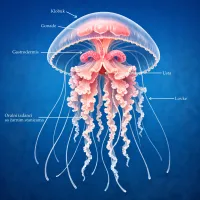
What Are Jellyfish?
Jellyfish, commonly known as medusae, belong to the phylum Cnidaria, which also includes corals. They are gelatinous planktonic organisms, with bodies composed of 95–98% water. Like other cnidarians, jellyfish have stinging cells (cnidocytes) used to capture prey. They lack a central nervous system; instead, they have a network of nerves and sensory organs, and some species also possess photoreceptors that respond to light and darkness.
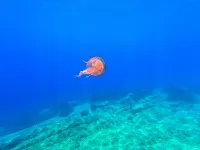
Currently, around 200 species of jellyfish have been described, distributed across all oceans. Most jellyfish have a complex life cycle that includes a polyp stage (asexual generation) and a medusa stage (sexual generation). However, some, like the mauve stinger (Pelagia noctiluca), occur only in the medusa form, while others exist only as polyps. Almost all jellyfish forms are planktonic, living in the water column, and their movement largely depends on water currents, although some species, such as the upside-down jellyfish (Cassiopea xamachana), spend much of their life on the seafloor.
Jellyfish play an important role in nature—they serve as food for many fish and help monitor the health of marine ecosystems. In addition, certain species are now used in biomedical research, contributing to scientific advancement.
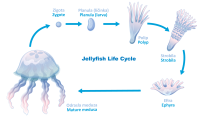
Life Cycle
Jellyfish have a complex life cycle that involves the alternation of a sexual (medusa) and an asexual (polyp) generation. The adult medusa is a sexually mature individual that swims freely in the sea. Males produce sperm and females produce eggs; after fertilization, a zygote is formed, which develops into a planula.
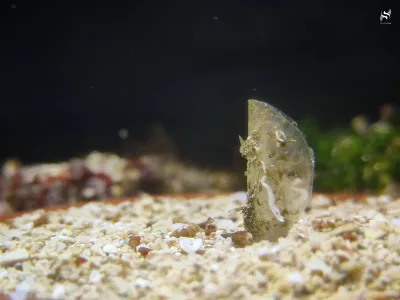
The planula is an oval, ciliated larva that swims freely for some time before attaching to a solid substrate and transforming into a polyp. The polyp represents the asexual phase of the life cycle.
In true jellyfish (class Scyphozoa), the polyp undergoes a special process called strobilation. During strobilation, the body of the polyp becomes transversely segmented, and young jellyfish—called ephyrae—are formed from these segments. Depending on the species, a polyp may produce a single ephyra (monodisc strobilation) or several ephyrae (polydisc strobilation). In polydisc strobilation, multiple successive segments are formed, each developing into an individual ephyra. Each ephyra then grows and develops into an adult jellyfish, completing the life cycle and beginning it again.
For aquarium work, the polyp stage is the most important. Because polyps are small and attached to a substrate, they are easier to maintain than adult jellyfish and allow for the controlled production of young individuals throughout the year. By regulating conditions such as temperature, light, and feeding, strobilation can be stimulated or slowed down, thereby controlling the number of jellyfish in the aquarium. For this reason, polyps are essential for the successful breeding and maintenance of jellyfish populations under controlled conditions.
Systematics
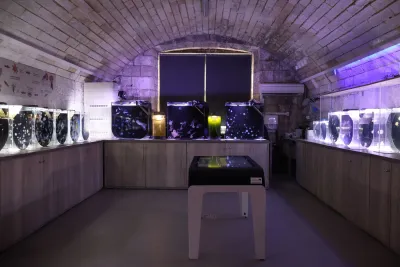
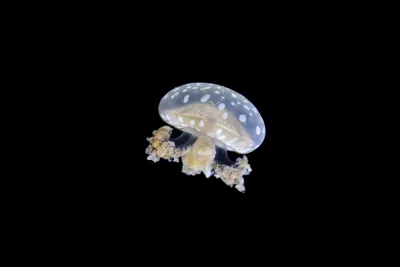
As part of the jellyfish exhibition, visitors have the opportunity to discover the diverse world of Mediterranean and exotic species. Mediterranean representatives include Aurelia sp., Chrysaora hysoscella, Cotylorhiza tuberculata, Mnemiopsis leidyi, Pelagia noctiluca and Rhizostoma pulmo. The exhibition also features exotic species such as Cassiopea sp., Catostylus mosaicus, Chrysaora chesapeakei, Chrysaora colorata, Chrysaora fuscescens, Chrysaora plocamia, Lychnorhiza lucerna, Mastigias papua, Phyllorhiza punctata, Rhopilema esculentum, Sanderia malayensis and Stomolophus sp., further enriching the exhibition with their diversity of shapes and colours.
Buy tickets for Aquarium Pula, quickly and easily