We respect your privacy










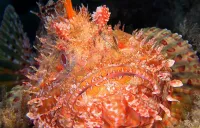
Unlike some other fish species, the sex of a scorpionfish cannot be reliably determined by its colour, body shape, fins or skin appendages, as males and females look almost identical externally. It was only the egg-laying, which we have been observing every two weeks during the summer months, that revealed the presence of adult females in our tank. In fact, sex can only be determined with certainty by examining the reproductive organs, for example through ultrasound, endoscopy or histological analysis. The only more noticeable difference is that females generally grow larger and live longer, meaning that particularly large and old individuals are more likely to be female.
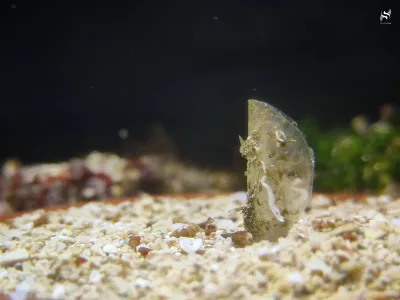
In the wild, scorpionfish generally spawn during the summer, most often at night, when they are less exposed to predators. Unlike many other fish, scorpionfish do not lay their eggs on a substrate but release them in the form of a large gelatinous mass that floats freely in the sea. This mass can reach several dozen centimetres or even more than a metre in length. Thousands of tiny eggs, each less than one millimetre in diameter, are contained within this transparent “sea veil”. The mass is almost invisible, ranging from transparent to slightly milky in appearance, which often makes it difficult to spot in the wild. However, some of our more observant visitors may have noticed it in the tank.
Further microscopic analysis revealed that the eggs were unfertilised. In order to act responsibly towards the marine environment and the animals in our care, we returned the gelatinous egg mass to the sea, where it will continue its natural journey.
Nature continues to surprise us, even when we think we know almost everything about a particular species. This is why every event like this represents a valuable opportunity to learn, observe and better understand life beneath the surface of the sea.