We respect your privacy










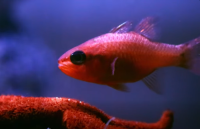
Apogon imberbis is a native species of the southern Adriatic that we have been recording with increasing frequency in the waters around Pula over the past three years, a trend also confirmed by reports from other divers. The first official records along the Istrian coast were documented in the Brijuni Islands in 2024, followed by a record near Rovinj in 2025 (Mavrič et al., 2025). Its northward expansion and increasing abundance are most likely linked to the warming of the Adriatic Sea.
The species is recognizable by its reddish body, large dark eyes with a white stripe above and below the pupil, a dark stripe on the head, and black pigmentation at the base of the tail. The cardinalfish is active at night; during the day, it hides in caves, crevices and other shaded areas, emerging at dusk in search of food.
These fish often gather in groups, while during courtship and spawning they form temporary pairs. Interestingly, this is the only native Adriatic species in which the male carries and protects the fertilized eggs in its mouth. In several cases, females have also been observed taking on a protective role after spawning, “patrolling” the area around the spawning site.
In aquarium conditions, it is important to provide cardinalfish with sufficient hiding places and keep them in appropriately sized groups. At Aquarium Pula, we have successfully kept this species for many years in a habitat featuring bushy corals, sponges and numerous crevices and fissures, representing the shallower areas of Mediterranean coral reefs.