We respect your privacy


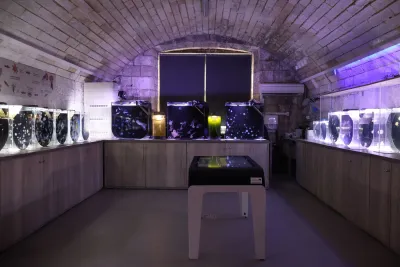







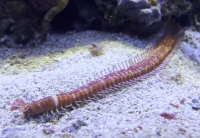
An Adriatic polychaete of the genus Eunice suddenly emerged from its hiding place in one of our tanks!
Last week, we were surprised by an unusual “guest” in a tank housing juvenile common cuttlefish (Sepia officinalis). It most likely entered the tank with sand or rocks and was identified as a polychaete of the genus Eunice, a group of marine “worms”, some species of which are used as fishing bait.
Polychaetes (Polychaeta) are a diverse and widespread group of marine animals. Around 560 species have been recorded in the Adriatic Sea, traditionally divided into primitive polychaetes (Archiannelida), free-living polychaetes (Errantia), and tube-dwelling polychaetes (Sedentaria).
The polychaete found in our tank belongs to the free-living genus Eunice. Its body consists of numerous segments, with parapodia used for locomotion and bearing the bristles from which polychaetes get their name. Behind the head are two characteristic appendages, while the head bears five antennae (cirri tentacularis), which help it detect stimuli and locate prey. Once prey is detected, the worm seizes it with its powerful jaws and quickly pulls it into its hiding place. White rings behind the head occur in some species and are particularly visible in young individuals.
Its lightning-fast retreat is made possible by the coordinated action of the nervous and muscular systems. Nerve impulses travel rapidly along large nerve fibres in the ventral nerve cord, simultaneously activating longitudinal and transverse muscles across numerous segments and causing the body to contract abruptly.
Interestingly, some species of the genus Eunice grow to only a few centimetres in length, while Eunice aphroditois can reach up to 3 metres. Large polychaete species are often referred to as “Bobbit worms”, a name associated with the controversial 1993 case involving Lorena and John Bobbitt.