We respect your privacy









About the project
A joint project between Aquarium Pula d.o.o. and Calucem d.o.o. is focused on the development and application of urban photo-bioreactors that use microalgae to absorb CO₂, produce oxygen and improve air quality in urban areas. The project connects science, technology, environmental protection and the local community and brings a concrete, visible and measurable solution for urban areas, while simultaneously contributing to the development of innovative approaches to nature conservation.
The project is co-financed by Calucem d.o.o. through the socially responsible TechInspire program. The contract was signed in 2025, the jubilee year in which Aquarium Pula celebrates 25 years and Calucem 100 years of existence, by Juan Martinez, General Manager of Calucem, Samantha Oharek, Director of Calucem in Croatia, and Dr. sc. Milena Mičić, President of the Board of Aquarium Pula.
Project objectives:
- Reducing the impact of CO₂ emissions, improving air quality and reducing other compounds such as sulfur and nitrogen oxides.
- Reducing the diffuse entry of CO₂ into the Adriatic Sea, which contributes to the reduction of acidification and the preservation of biodiversity.
- Investigating the possibility of using algal biomass obtained at the Calucem plant as a food source.
- Transfer of knowledge and technology through sharing the results of prototype development and their application in the wider community.
- Public education about the importance of microalgae in improving air quality, combating climate change and protecting the Adriatic Sea.
Phase 1: Prototype Testing and Development (2025)
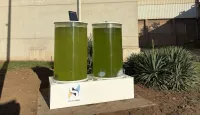
Phase 1 includes testing the prototype during 2025 at two locations: inside the Calucem factory and in front of the Pula Aquarium. The system consists of two pools with a capacity of 300 liters, filled with sea water with different types of microalgae. Microalgae absorb CO₂, produce oxygen and contribute to air purification from nitrate and sulfur compounds. The effect of one photo-bioreactor is comparable to the effect of one tree or approximately 200 m² of lawn.
Phase 2: System development and scaling
Phase 2 includes placing a larger photo-bioreactor at selected locations, defined on the basis of data from Phase 1. The goal is to optimize the system and adapt it to real urban conditions for long-term efficiency and sustainability.
Phase 3: Implementation in the local community
The final phase refers to the implementation of the system in the local community. In cooperation with partners and the City of Pula, public areas will be selected for the installation of photo-bioreactors. The goal is wider implementation of the technology and active involvement of the community.